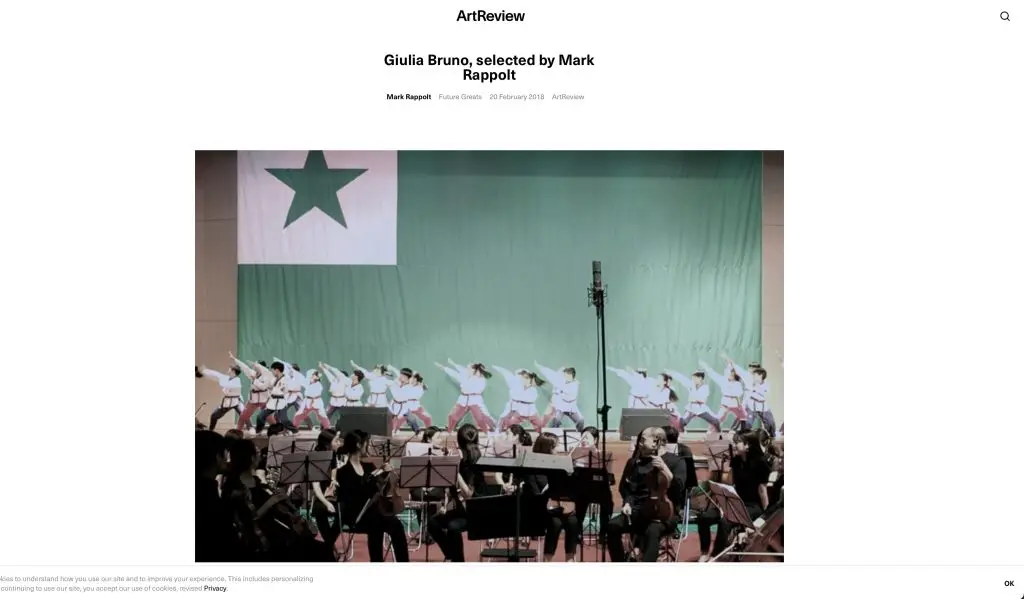
Giulia Bruno featured in ArtReview Future Greats Giulia Bruno was featured in the Future Greats series of ArtReview (January–February 2018 issue), which highlights emerging voices shaping the future of contemporary art. In the article written by Mark Rappolt, Bruno is recognized for her ability to produce visually and conceptually dense works that resonate deeply with questions of language, technology, and perception. Her project Artificial Act. Research for a Film (2017–), presented at the Off-Biennale Budapest, serves as a central point of discussion. The work explores the constructed nature of communication and translation through the lens of Esperanto — the “universal language” — opening a reflection on power, ideology, and global interconnection. Bruno’s inclusion in Future Greats acknowledges her ongoing research at the intersection of image, science, and society, and positions her among the artists to watch in the coming years.
Photo Giulia Bruno, 2018
Accessibility
Accessibility modes
Epilepsy Safe Mode
Dampens color and removes blinks
This mode enables people with epilepsy to use the website safely by eliminating the risk of seizures that result from flashing or blinking animations and risky color combinations.
Visually Impaired Mode
Improves website's visuals
This mode adjusts the website for the convenience of users with visual impairments such as Degrading Eyesight, Tunnel Vision, Cataract, Glaucoma, and others.
Cognitive Disability Mode
Helps to focus on specific content
This mode provides different assistive options to help users with cognitive impairments such as Dyslexia, Autism, CVA, and others, to focus on the essential elements of the website more easily.
ADHD Friendly Mode
Reduces distractions and improve focus
This mode helps users with ADHD and Neurodevelopmental disorders to read, browse, and focus on the main website elements more easily while significantly reducing distractions.
Blindness Mode
Allows using the site with your screen-reader
This mode configures the website to be compatible with screen-readers such as JAWS, NVDA, VoiceOver, and TalkBack. A screen-reader is software for blind users that is installed on a computer and smartphone, and websites must be compatible with it.